


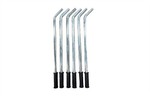
What is the hardness level of massage chair metal accessories?
As a supplier of Massage Chair Metal Accessories, I often get asked about the hardness level of the metal accessories used in massage chairs. Understanding the hardness of these components is crucial as it directly impacts the performance, durability, and overall quality of the massage chair.
Importance of Hardness in Massage Chair Metal Accessories
Hardness is a fundamental property of metals that refers to their resistance to deformation, indentation, or scratching. In the context of massage chairs, metal accessories such as Handle Connection Assembly and Chain Cover need to have appropriate hardness levels to withstand the stresses and strains they encounter during normal use.
For example, the handle connection assembly is responsible for providing a stable and secure connection between the massage chair's handle and the main body. If the metal used in this assembly is too soft, it may bend or deform over time, leading to a loose or unstable handle. On the other hand, if the metal is too hard, it may become brittle and prone to cracking, which can compromise the safety and functionality of the massage chair.
Similarly, the chain cover protects the chains and gears inside the massage chair from dust, dirt, and other contaminants. It also helps to reduce noise and vibration during operation. A chain cover made of a metal with the right hardness level will be able to withstand the impact of moving parts and resist wear and tear, ensuring long - term performance and reliability.
Measuring Hardness
There are several methods used to measure the hardness of metals, with the most common ones being the Brinell, Rockwell, and Vickers hardness tests.
The Brinell hardness test involves pressing a hard, spherical indenter into the surface of the metal at a specified load for a certain period. The diameter of the indentation left on the metal surface is then measured, and the Brinell hardness number (BHN) is calculated based on the load and the area of the indentation.
The Rockwell hardness test uses a diamond cone or a hardened steel ball as an indenter. A minor load is first applied to seat the indenter, followed by a major load. The difference in the depth of penetration between the minor and major loads is measured, and the Rockwell hardness number (HR) is determined.
The Vickers hardness test is similar to the Brinell test but uses a square - based pyramid indenter. The diagonal length of the indentation is measured, and the Vickers hardness number (HV) is calculated.
Ideal Hardness Levels for Different Massage Chair Metal Accessories
The ideal hardness level for massage chair metal accessories depends on their specific functions and the materials used.
For handle connection assemblies, a medium - high hardness level is usually preferred. Metals such as stainless steel with a Rockwell hardness of around 20 - 30 HRC (Rockwell C scale) are commonly used. This hardness range provides a good balance between strength and ductility, allowing the assembly to withstand normal use without being too brittle.
Chain covers can be made from a variety of metals, including aluminum and steel. Aluminum chain covers typically have a lower hardness compared to steel ones. For aluminum chain covers, a Brinell hardness of around 20 - 30 BHN is often sufficient, as aluminum is a relatively lightweight and corrosion - resistant metal. Steel chain covers, on the other hand, may have a Rockwell hardness of 15 - 25 HRC, depending on the type of steel used.


Factors Affecting Hardness
Several factors can affect the hardness of massage chair metal accessories. The composition of the metal alloy is one of the most significant factors. Different elements added to the base metal can alter its hardness, strength, and other properties. For example, adding carbon to iron to form steel can increase its hardness, with higher carbon content generally resulting in harder steel.
The heat treatment process also plays a crucial role in determining the hardness of metals. Annealing, quenching, and tempering are common heat treatment methods used to modify the hardness of metals. Annealing involves heating the metal to a specific temperature and then slowly cooling it, which reduces its hardness and increases its ductility. Quenching, on the other hand, involves rapid cooling, which can significantly increase the hardness of the metal. Tempering is often done after quenching to relieve internal stresses and improve the toughness of the metal.
Quality Control and Assurance
As a supplier of massage chair metal accessories, quality control and assurance are of utmost importance. We use advanced testing equipment to measure the hardness of our products and ensure that they meet the required standards. Each batch of metal accessories undergoes rigorous testing before being shipped to our customers.
We also work closely with our material suppliers to source high - quality metals with consistent properties. By carefully controlling the manufacturing process, from raw material selection to final finishing, we can ensure that our massage chair metal accessories have the right hardness level and other mechanical properties.
Conclusion
The hardness level of massage chair metal accessories is a critical factor that affects the performance, durability, and safety of massage chairs. As a supplier, we understand the importance of providing high - quality accessories with the appropriate hardness levels. Whether it's the handle connection assembly or the chain cover, we strive to use the best materials and manufacturing processes to ensure that our products meet the needs of our customers.
If you are in the market for high - quality massage chair metal accessories, we invite you to contact us for a detailed discussion about your requirements. Our team of experts is ready to assist you in selecting the right products for your massage chairs. We look forward to the opportunity to work with you and contribute to the success of your business.
References
- Callister, W. D., & Rethwisch, D. G. (2011). Materials Science and Engineering: An Introduction. Wiley.
- ASM Handbook Committee. (1990). ASM Handbook: Volume 8 - Mechanical Testing and Evaluation. ASM International.
- Dieter, G. E. (1988). Mechanical Metallurgy. McGraw - Hill.